
Preparing for Your Accountant or Auditor: A Practical Checklist for Singapore Entities
Jan 18, 2026 | A structured approach to make year-end smoother and more efficient. Whether you are working with an external accountant to prepare your financial statements or engaging an auditor for statutory or other assurance work, good preparation can significantly reduce stress, delays and unexpected issues...
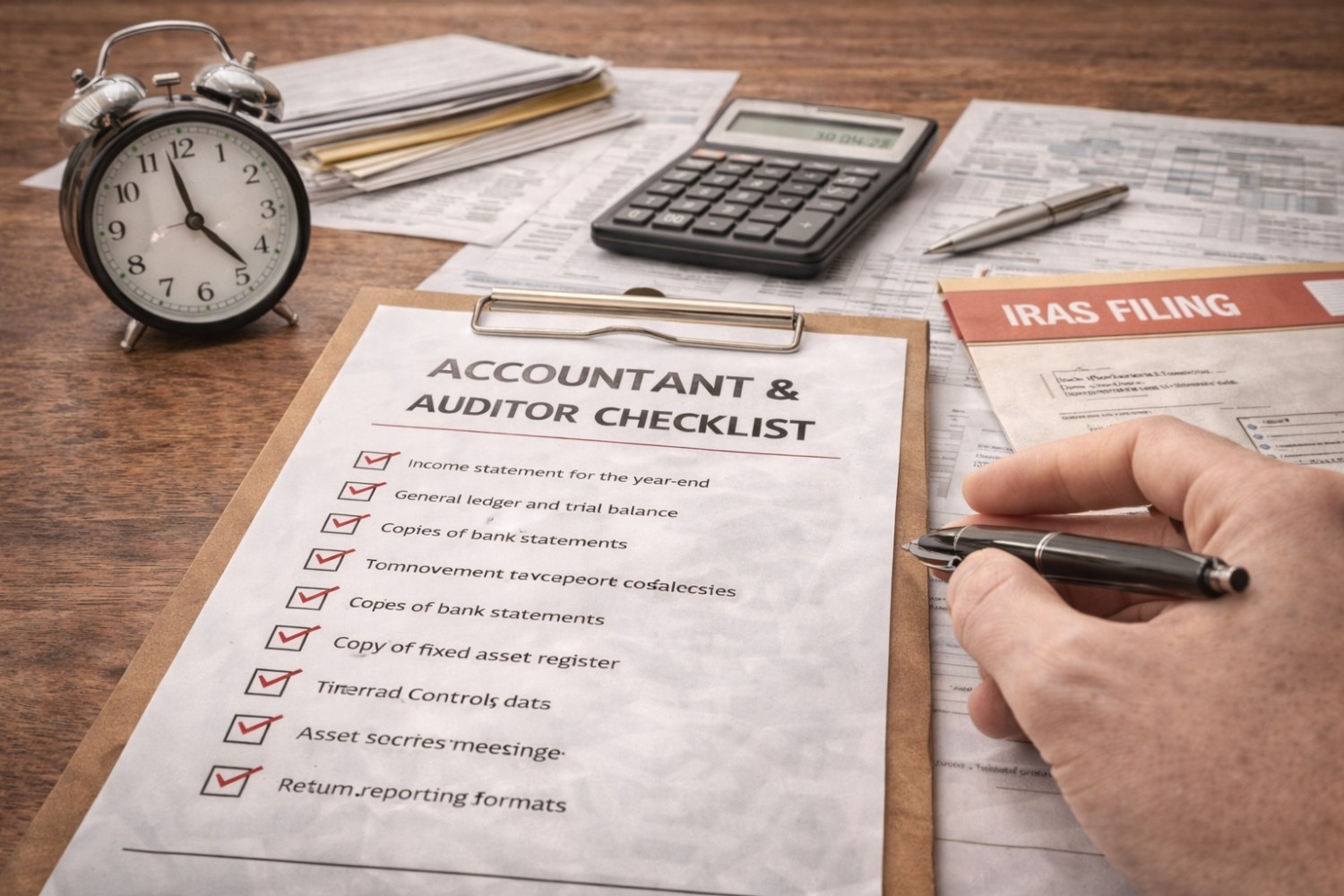
Whether you are working with an external accountant to prepare your financial statements or engaging an auditor for statutory or other assurance work, good preparation can significantly reduce stress, delays and unexpected issues.
This article provides a practical checklist for Singapore entities to prepare for year-end, covering key areas that accountants and auditors commonly focus on.
1. Start with the basics: financial year end and deadlines
Before diving into details, confirm:
- Your financial year end (FYE) (e.g. 31 December, 31 March).
- Statutory and internal deadlines, such as:
- Board approval of financial statements
- AGM (if applicable)
- ACRA Annual Return filing
- IRAS ECI and Form C-S/C filing
- Bank or lender reporting deadlines
Share this timeline with your accountant or auditor early and agree a work plan that allows enough time for preparation, review and approvals.
2. Close the books and reconcile key balances
A good year-end close starts with tidy accounting records. Before handing over to your accountant or auditor, aim to:
- Post all routine transactions up to year-end:
- Sales and receipts
- Purchases and payments
- Payroll and staff expenses
- Bank charges, interest income/expense
- Reconcile key accounts:
- Bank accounts vs bank statements
- Trade receivables and trade payables vs detailed listings
- GST control accounts vs GST returns (if applicable)
- Intercompany balances vs confirmations or counterpart schedules
- Clear suspense and temporary accounts where possible and reclassify properly.
The more complete and reconciled your ledger is, the faster your accountant or auditor can focus on analysis and judgement areas rather than basic housekeeping.
3. Prepare supporting schedules for major balances
Accountants and auditors rely on supporting schedules to understand and test account balances. Common schedules include:
Trade receivables
- Aged listing of customers showing outstanding balances by age bucket
- Notes on long-outstanding or disputed items
Trade payables
- Aged listing of suppliers
- Notes on significant or unusual balances
Accruals and provisions
- Breakdown by type (e.g. audit fees, utilities, staff bonuses)
- Basis of estimate and status of related invoices or contracts
Prepayments
- Listing of prepayments (e.g. insurance, rentals, maintenance contracts) and periods they cover
Fixed assets
- Fixed asset register with cost, additions/disposals, accumulated depreciation and net book value
- Support for major additions (invoices, contracts) and disposals
Loans and borrowings
- Loan summary showing lender, principal, interest rate, maturity, security and covenants
- Latest loan statements or confirmations
Well-prepared schedules reduce follow-up queries and show that balances are actively monitored.
4. Review revenue and expense cut-off
Cut-off issues are a common source of adjustments in audits and reviews.
Practical steps:
- Identify invoices near year-end (before and after FYE) and check whether revenue is recognised in the correct period.
- Review sales returns, credit notes or major discounts issued after year-end and assess whether they relate to the prior period.
- For significant projects or contracts, document the basis of revenue recognition (e.g. completion, percentage-of-completion, milestones).
For expenses:
- Check that recurring costs (e.g. utilities, rental, professional fees) are accrued where invoices are received after year-end but relate to the prior period.
- Review post year-end invoices for goods or services delivered before year-end and accrue where necessary.
This preparation will help you explain cut-off judgements to your accountant or auditor clearly.
5. Assess receivables, inventory and other key estimates
Accountants and auditors will often focus on areas involving judgement, such as:
- Expected credit losses (ECL) on trade receivables
- Inventory obsolescence and write-downs
- Provisions (e.g. legal disputes, warranties, onerous contracts)
- Impairment of investments or assets where performance is weak
Before the engagement:
- Prepare an aged receivables analysis and identify doubtful accounts; document follow-up actions and any proposed write-off or allowance.
- Review inventory ageing, slow-moving or damaged items, and determine whether write-downs are required; support this with sales history or current selling prices.
- Document the basis for major provisions – what is the obligation, how was the estimate derived, and what events or evidence support it?
Having a short management paper or memo on key estimates can be very helpful during discussions.
6. Compile legal and contractual documents
Your accountant or auditor may need to review important contracts and documents, such as:
- Major customer and supplier contracts
- Lease agreements
- Bank and loan agreements, including security documents
- Shareholder agreements and key corporate documents
- Significant grant or funding agreements
- Board and shareholder minutes and resolutions
Organising these in advance (physical or digital folders) makes the engagement more efficient and reduces last-minute document searches.
7. Related parties and director matters
Related party balances and transactions are a common focus area, especially for owner-managed businesses.
Prepare:
- A list of related parties (directors, major shareholders and entities they control or influence).
- Schedules of related party transactions during the year (e.g. sales, purchases, management fees, rentals, loans).
- Details of director loans, director’s current account movements and any personal guarantees given to banks or suppliers.
Ensure arrangements are:
- Documented (e.g. agreements for rentals or loans)
- Consistent with what is recorded in the books
- Reasonably aligned with arm’s length principles where relevant.
This information is also important for disclosure in the financial statements.
8. Tax matters and deferred tax (if applicable)
For tax:
- Prepare or update your tax computation for the year, including major add-backs and deductions.
- Ensure ECI filing has been done or is planned.
- Gather IRAS correspondences, Notices of Assessment and any ongoing queries or audits.
If deferred tax is relevant:
- Identify major temporary differences between accounting and tax bases (e.g. depreciation vs capital allowances, provisions not yet deductible).
- Provide schedules to your accountant or auditor for review.
Clear tax documentation helps align the financial statements with actual tax exposures.
9. Internal check before handing over
Before you formally “hand over” the accounts, it can be useful to perform a simple internal review:
- Compare current year vs prior year financial statements for large, unexplained movements.
- Check that trial balance totals tie to draft financial statements.
- Confirm that major balance sheet items are supported by schedules, reconciliations and documents.
- Ensure that obvious errors (e.g. mispostings, duplicate entries) are corrected.
This internal check can catch issues early and demonstrates that management has taken ownership of the numbers.
10. Communication and expectations
Good communication with your accountant or auditor makes the process smoother:
- Share your timeline and constraints (e.g. key staff availability, board meetings).
- Discuss any unusual transactions during the year (e.g. acquisitions, disposals, restructuring, grants).
- Be open about known issues or uncertainties – it is better to address them early than to have surprises late in the process.
Agree on:
- the scope of work (e.g. statutory audit, review, compilation, agreed-upon procedures),
- the deliverables (e.g. full financial statements, management letter, tax computations), and
- the communication protocol – who will be the main contact and how queries will be handled.
11. How Ascern can help
At Ascern, we support Singapore entities by:
- guiding finance teams through year-end preparation and checklists,
- preparing or reviewing financial statements under SFRS / SFRS for Small Entities / CAS (for eligible NPOs),
- performing statutory audits, reviews or agreed-upon procedures, and
- assisting with tax computations, ECI, Form C-S/C and related documentation.
Our goal is to make the process structured, clear and value-adding, rather than a last-minute scramble.
If you would like help tailoring a year-end checklist to your business or planning your next reporting cycle, we would be pleased to assist.
Elevate Your Boardroom Dynamic
Discover how our strategic governance solutions can transform your organization's leadership and decision-making processes.