
Charities and IPCs in Singapore: Key Financial Reporting and Governance Expectations
Feb 11, 2026 | What boards, committees and management teams should pay attention to. Charities and Institutions of a Public Character (IPCs) in Singapore are entrusted with public and donor funds to deliver social, community and charitable outcomes. With this comes heightened expectations...
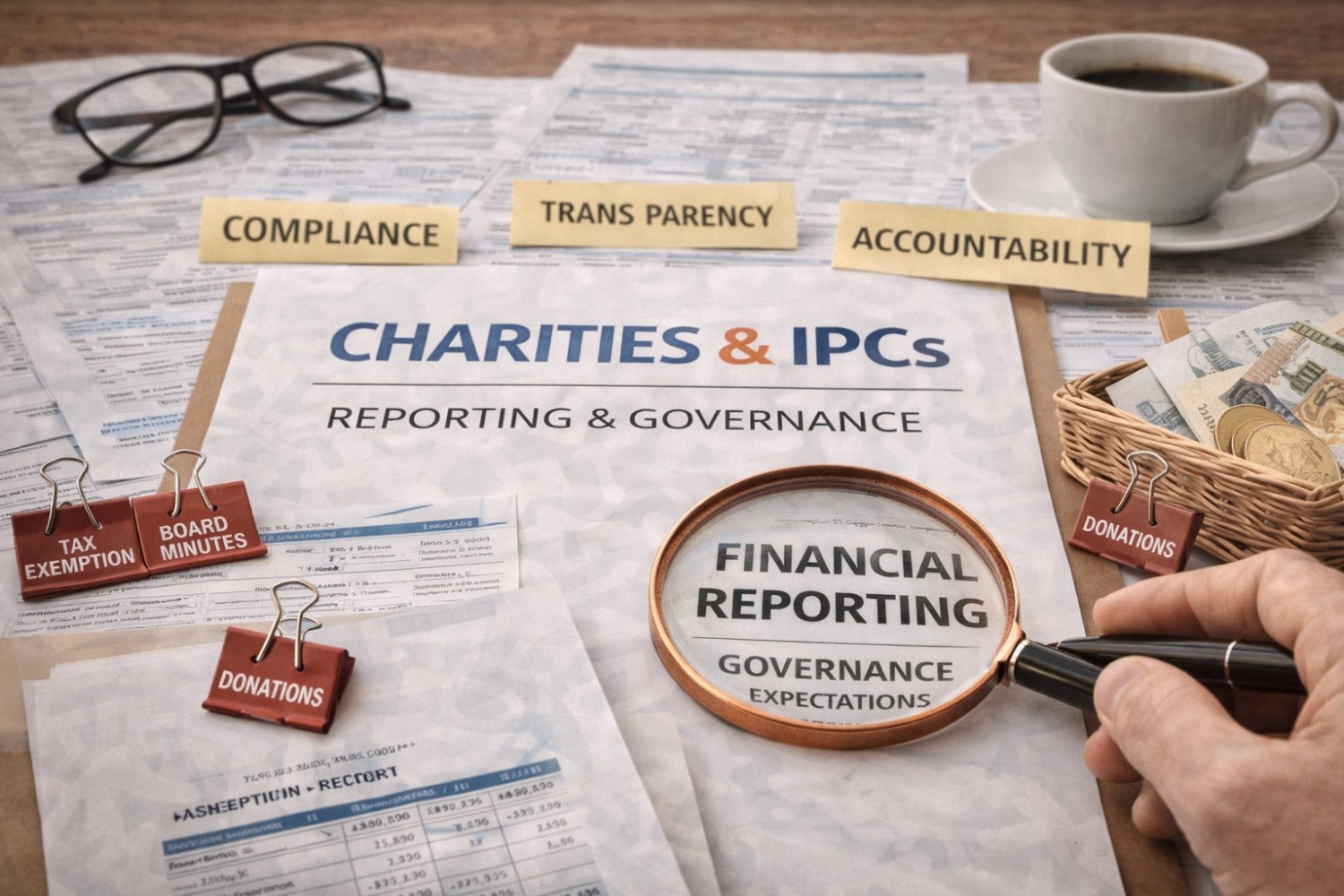
Figure 1: Upholding Public Trust
Charities and Institutions of a Public Character (IPCs) in Singapore are entrusted with public and donor funds to deliver social, community and charitable outcomes.
With this comes heightened expectations around financial reporting, accountability and governance from regulators, donors, grant-makers and the public.
This article summarises key themes that boards, management committees and senior staff should be aware of, particularly in the areas of financial reporting, internal controls and governance practices.
Note: Requirements vary by legal form (e.g. charity, IPC, CLG, society) and size. Always refer to the latest guidance issued by the relevant regulators.
1. Understanding your regulatory and reporting landscape
The expectations for a charity or IPC depend on factors such as:
- legal structure (e.g. charitable trust, society, company limited by guarantee),
- whether it is an IPC and enjoys tax-deductible donations,
- annual income and asset size, and
- whether it receives significant government grants or public donations.
Boards should know:
- which regulators apply (e.g. Commissioner of Charities, sector administrators, ACRA, IRAS),
- which financial reporting framework is used (e.g. Charities Accounting Standard (CAS) or SFRS), and
- what level of assurance is required (audit, review, or other).
Clarity on this “map” helps boards plan the right processes and resources around reporting and governance.
2. Financial reporting: CAS vs SFRS and fund accounting
Many charities and IPCs in Singapore either:
- adopt the Charities Accounting Standard (CAS), or
- apply SFRS / SFRS for Small Entities if they are larger or have more complex activities.
Regardless of framework, key expectations include:
- presenting a Statement of Financial Activities (SOFA) or equivalent,
- distinguishing between restricted, unrestricted and designated funds, and
- disclosing movements between funds clearly.
Boards should ensure that:
- incoming resources (donations, grants, programme income) are recognised based on terms and conditions,
- expenditure is properly classified (charitable activities, fund-raising, governance, administration), and
- reserves and fund balances are transparently presented, including any reserves policy and rationale.
The financial statements should help stakeholders understand how funds were received, used and carried forward.
3. Reserves, designated funds and restricted donations
Reserves and fund balances are often sensitive topics in the charity sector.
Key expectations:
- Charities and IPCs should have a clear reserves policy, explaining:
- why reserves are held,
- how the level is determined (e.g. months of operating expenditure), and
- how the policy is reviewed.
- Restricted funds (donor-imposed conditions) must only be used for their intended purposes and reported separately.
- Designated funds (set aside by the board from unrestricted funds) should be supported by board decisions or resolutions.
Boards should regularly review:
- whether restricted funds are being utilised in accordance with donor intentions,
- whether designated funds remain appropriate, and
- whether the overall reserves level is reasonable in view of operational risks and programme commitments.
Transparent disclosure helps address donor questions such as “Why is the charity holding so much cash?” or “Are donations really going where they were intended?”.
4. Governance structures and board oversight
Regulators and donors expect charities and IPCs to demonstrate sound governance, not just technical compliance. This includes:
- a functioning board or management committee that provides oversight of:
- strategy and programmes,
- financial performance and key risks,
- internal controls and compliance.
- clear roles and responsibilities between the board, sub-committees (e.g. audit/finance, programmes, fund-raising) and management.
- regular board meetings, with:
- timely financial reports and budget vs actual comparisons,
- clear minutes documenting key decisions,
- follow-up on action items and audit recommendations.
Boards should be able to explain how they:
- oversee financial reporting and audit,
- manage conflicts of interest, and
- ensure that resources are used effectively and in line with charitable purposes.
5. Internal controls and segregation of duties
Limited resources are a reality in many charities and IPCs, but some basic internal controls are still expected, such as:
- segregation of duties for:
- receipts and banking of donations,
- approval and payment of expenses,
- recording and reconciliation of bank accounts.
- documented approval limits and authorisation procedures (e.g. for payments, contracts, staff claims).
- regular bank reconciliations, reviewed by someone other than the preparer (e.g. a board treasurer or finance committee member).
- proper documentation for:
- grant agreements and reporting,
- procurement and vendor selection,
- major programme and capital spending.
Even simple checklists and sign-off processes can significantly strengthen financial governance in smaller organisations.
6. Related party transactions and conflict of interest management
Related party transactions are particularly sensitive when public or donor funds are involved.
Key expectations:
- a documented conflict of interest policy, communicated to board members and senior staff;
- regular declarations of interests by board members and key personnel;
- procedures for handling conflicts (e.g. recusal from decisions, independent review);
- transparent disclosure of:
- related party relationships,
- significant related party transactions,
- remuneration and benefits of key management personnel.
Boards should ensure that any transactions with board members, related entities or significant donors are:
- clearly justified as in the best interests of the charity,
- properly approved, and
- disclosed in financial statements and, where required, in governance or annual reports.
7. Fund-raising, grant reporting and use of donations
Stakeholders expect clarity on how funds raised are used. From a financial reporting and governance perspective, charities and IPCs should:
- track fund-raising projects and related costs, to allow reporting on:
- funds raised,
- fund-raising expenses,
- net amount available for programmes.
- comply with grant conditions, including:
- eligible expenditure,
- co-funding requirements,
- reporting timelines and formats.
- retain documentation for:
- donor-imposed restrictions,
- naming rights or recognition agreements,
- significant in-kind donations.
Boards should receive regular updates on:
- performance of key fund-raising campaigns,
- grant utilisation and balances,
- any instances where conditions or covenants may not have been fully met and how they are being addressed.
8. Audit, assurance and management letter follow-up
Many charities and IPCs are subject to statutory audit or some form of external assurance, based on size or regulatory status.
Boards should:
- ensure an independent auditor is appointed in accordance with legal and regulatory requirements;
- approve the scope and timing of audit or review engagements;
- review and discuss the financial statements and any management letter with both management and the auditor.
A key governance expectation is that boards:
- follow up on audit findings or recommendations,
- agree on action plans and timelines, and
- monitor progress in subsequent meetings.
Where resources are constrained, boards can prioritise addressing higher risk findings first (e.g. cash controls, segregation of duties, related party matters).
9. Transparency to stakeholders: annual reports and communication
Beyond technical financial statements, charities and IPCs are expected to communicate clearly with stakeholders through:
- annual reports that combine:
- narrative on activities and outcomes,
- key financial highlights and ratios,
- governance and compliance information.
- easily accessible information on:
- board composition,
- remuneration policies (especially for key management),
- reserves and fund utilisation.
Boards should view annual reporting as an opportunity to build trust, not just satisfy a formal requirement. Clear explanations of how resources were used to achieve outcomes can strengthen donor and public confidence.
10. Practical steps for strengthening financial reporting and governance
For boards and management teams looking to enhance their practices:
- Clarify frameworks and requirements: Confirm the applicable financial reporting framework, regulatory filings and assurance requirements.
- Map your financial processes: Document key processes around donations, grants, procurement and payments, highlighting internal controls and approval points.
- Review board information: Ensure the board receives regular, clear financial reports (not just at year-end) and that there is time to discuss them.
- Update policies and registers: Refresh conflict of interest policies, related party registers and reserves policy, and ensure they are actually used in decision-making.
- Plan ahead for audits and filings: Agree timelines for year-end closing, audit work, board approval and regulatory submissions.
How Ascern can support charities and IPCs
At Ascern, we work with charities, IPCs and non-profit organisations to:
- prepare or review financial statements under CAS or SFRS,
- provide statutory audits, independent reviews or agreed-upon procedures on specific funds or grants,
- assist boards and finance teams in strengthening internal controls and governance practices, and
- support the development of clear, meaningful financial and governance reporting to stakeholders.
Our aim is to help organisations meet regulatory expectations while presenting information that is transparent, understandable and aligned with their mission.
If your charity or IPC would like to review its financial reporting and governance practices, we would be pleased to assist.
Elevate Your Boardroom Dynamic
Discover how our strategic governance solutions can transform your organization's leadership and decision-making processes.